If you have a recent diesel, you probably have an AdBlue tank to fill from time to time, or the engine will refuse to restart. Here are the essentials.
What is AdBlue for?
AdBlue is a solution of urea in demineralised water (32.5% urea). It is injected into the exhaust, where an “SCR” (selective catalytic reduction) catalyst uses it to convert a large share of nitrogen oxides (NOx) into nitrogen and water vapour. This is what allows recent diesels to meet emissions standards.
How much do you use?
Consumption depends on the engine, your driving and the load, and the tank size varies from one model to another: your car’s owner’s manual gives the capacity and the usual range. The dashboard warns you well in advance when the level is getting low.
Don’t ignore it: if the AdBlue tank is empty, the engine will not restart once it has been switched off. This lock-out is required by emissions regulations, to prevent driving without emissions control. Top up as soon as the first warnings appear.
Where to buy it and how to fill up
- In cans (petrol stations, car centres, supermarkets) or from the pump at some stations, often on the lanes reserved for lorries for high-flow nozzles.
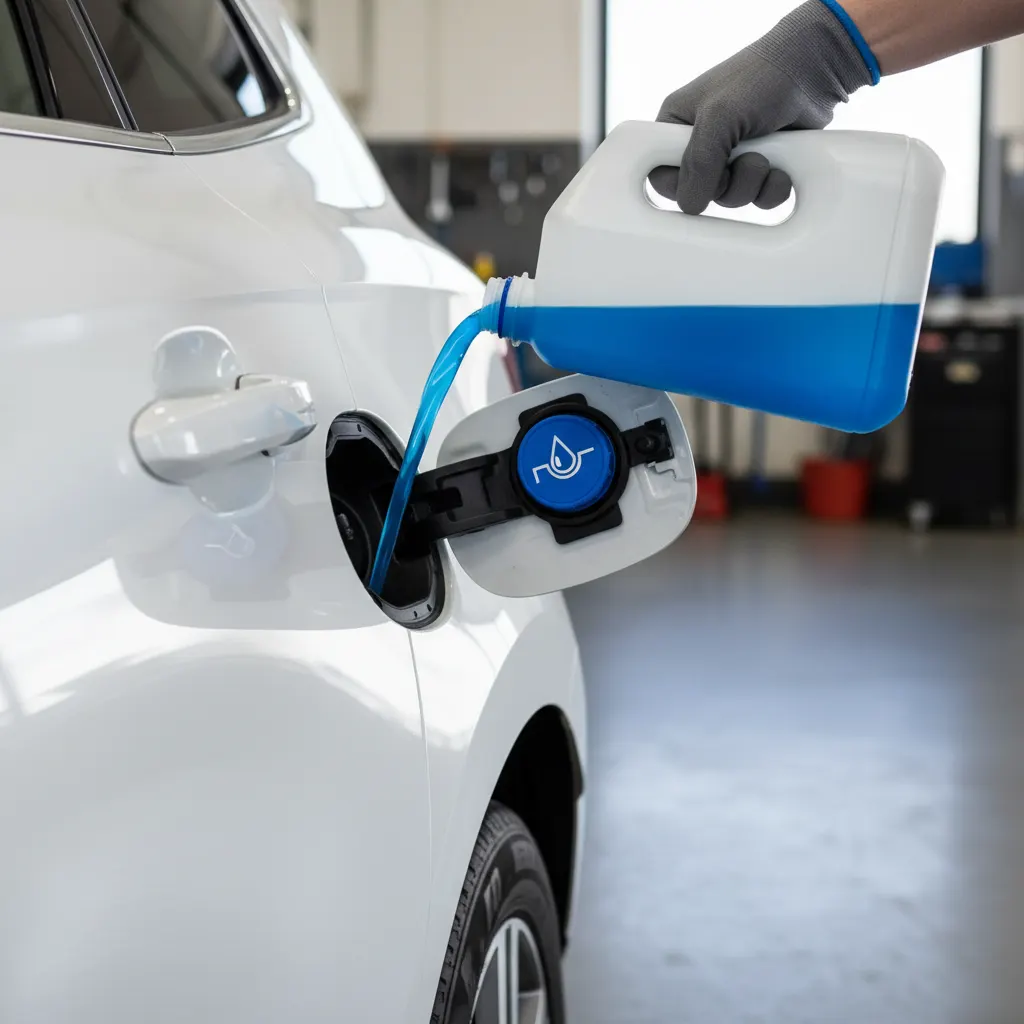
- The filler cap, often blue, is next to the fuel flap or in the boot, depending on the model: the owner’s manual tells you where.
- Use the can’s spout or a clean funnel kept for AdBlue only: the slightest impurity can damage the system.
- Store cans away from sunlight and frost.
The mistake to avoid
Never pour AdBlue into the fuel tank, or fuel into the AdBlue tank. If it has happened, do not start the engine: have the car towed to the garage, the repair will be much simpler.
Keep a record
Note your top-ups and any system faults (warning light, error message) in your maintenance log, with the date and mileage: it helps the mechanic if something goes wrong.